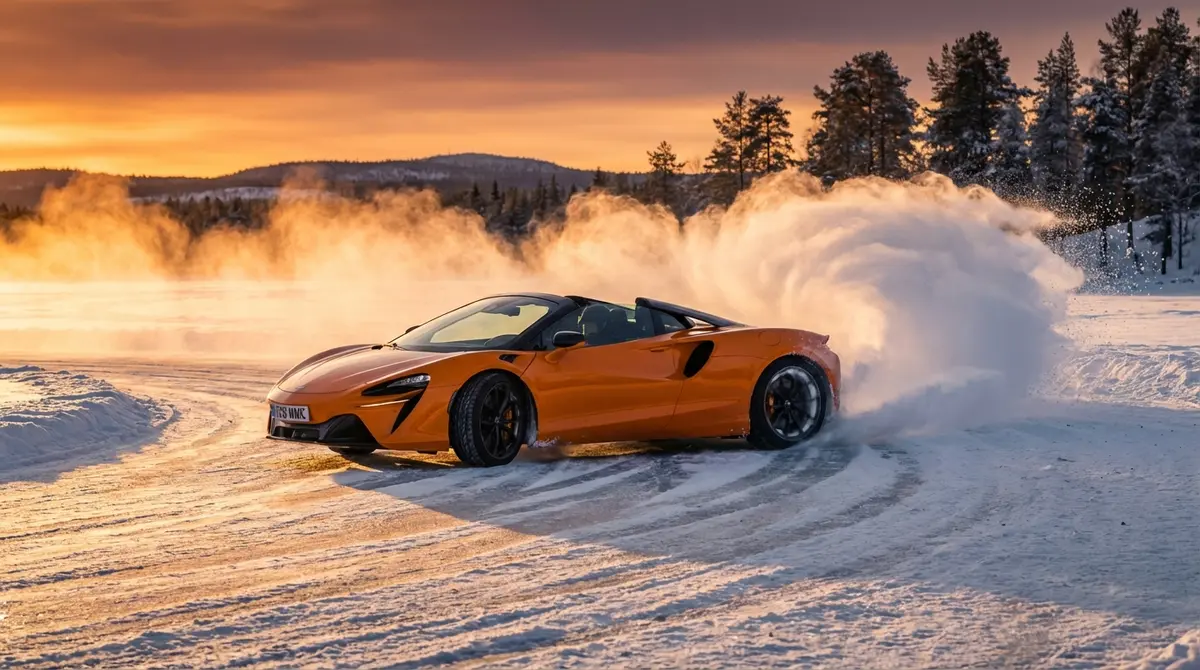
Two hundred miles north of the Arctic Circle, the air in Ivalo, Finland, bites with a ferocity that usually sends batteries into hibernation and mechanical fluids into sludge. Yet, against the backdrop of an endless white expanse, a roar pierces the silence. It is not the sound of a struggle, but of precision engineering at play. Here, on a frozen lake serving as nature’s skidpad, the 2025 McLaren Artura Spider is rewriting the rulebook on how supercars behave when traction is a memory.
The scene is the "Pure McLaren Arctic Experience," an annual pilgrimage for enthusiasts looking to master car control in the most unforgiving conditions. But this year, the spotlight falls on the durability and surprising agility of McLaren’s hybrid architecture. With 690 brake horsepower channeled through the rear wheels, one might expect a recipe for disaster on ice. Instead, thanks to a sophisticated marriage of electrified torque and software-defined chassis control, the Artura turns the terrifying prospect of a slide into a calculated ballet.
How does Variable Drift Control actually work?
For decades, stability control was the strict schoolmaster of the automotive world, slapping the driver’s wrist—or rather, cutting power and grabbing brakes—the moment a wheel stepped out of line. In the Artura Spider, however, the system has evolved into a co-pilot. The centerpiece of this evolution is the Variable Drift Control (VDC) system.
Sitting inside the cockpit, the driver is presented with a 15-stage slider on the infotainment screen. It functions less like a safety switch and more like a volume knob for courage. At the lower settings, the system intervenes early, keeping the car pointed straight. But as you slide your finger across the screen, increasing the angle, the software loosens its grip. It allows the rear tires to break traction and the car to rotate, yet it remains ready to catch the slide if the yaw angle exceeds the parameters set by the driver. According to reports from the event, this allows drivers to explore the limits of oversteer without the immediate penalty of a spin, effectively gamifying the learning curve of high-performance driving.
What role does the hybrid powertrain play in low-grip conditions?
While the software manages the angle, the powertrain manages the delivery. Drifting an internal combustion engine on ice can often be a jagged experience; waiting for turbos to spool or dealing with sudden spikes in torque can upset the car’s balance instantly. The Artura Spider utilizes its hybrid nature to solve this through a process McLaren calls "torque infill."
The powertrain combines a potent V6 engine with an electric motor. On the low-grip surface of the frozen lake, the electric motor acts as a smoothing agent. It fills in the gaps in the combustion engine’s power curve, providing instant, linear response the moment the driver touches the throttle. This precision is critical on ice, where a millimeter of pedal travel can be the difference between a controlled drift and a buried nose in a snowbank. The result is a seamless surge of power that makes the 690bhp output feel manageable rather than monstrous.
What was new for the 2025 Artura Spider?
The 2025 model year brought more than just a retractable hardtop to the Artura lineup. McLaren has refined the mechanicals to match the software’s sophistication. The gearbox now executes shifts 25 percent faster than its predecessor, a crucial upgrade when maintaining momentum in a slide requires rapid gear changes. Furthermore, revised damper valving improves how the car communicates surface imperfections to the driver, offering clearer feedback through the chassis.
Perhaps the most practical addition for the arctic environment is the new "Spinning Wheel Pull-Away" mode. In deep snow or ice, standard traction control can be overzealous, cutting power so aggressively that the car refuses to move. This new mode allows for significant wheel slip from a standstill, letting the tires claw through the loose powder to find grip below—a feature that proved essential during the tests in Ivalo.
Between the Lines
The successful deployment of the Artura Spider in the Arctic Circle is a deliberate signal to the market that the era of the "fragile hybrid" is over. By demonstrating that a high-performance battery and complex electric motor system can thrive in sub-zero conditions, McLaren is effectively removing the "seasonal" label from the supercar category. This benefits the manufacturer by validating the technology for year-round use, but the real winners are the consumers who no longer have to garage their investments for four months of the year. It suggests a future where software-defined handling, not just mechanical grip, becomes the primary differentiator in the luxury performance sector.
![Illustration related to McLaren Artura Spider: 690HP Variable Drift Control [Test]](https://story.bytewire.press/wp-content/uploads/bytewire-images/2026/02/mclaren-artura-spider-variable-drift-control-ice-test-40979336b9.webp)
![Diagram related to McLaren Artura Spider: 690HP Variable Drift Control [Test]](https://story.bytewire.press/wp-content/uploads/bytewire-images/2026/02/mclaren-artura-spider-variable-drift-control-ice-test-96c4536379.webp)