If you take a train north from London, you eventually hit the “Green Belt”—that protected ring of farms, forests, and meadows designed to stop the capital from sprawling into an endless concrete jungle. For decades, this land has been sacrosanct. But in Potters Bar, a commuter town on the edge of that green ring, the rules of the game have changed dramatically.
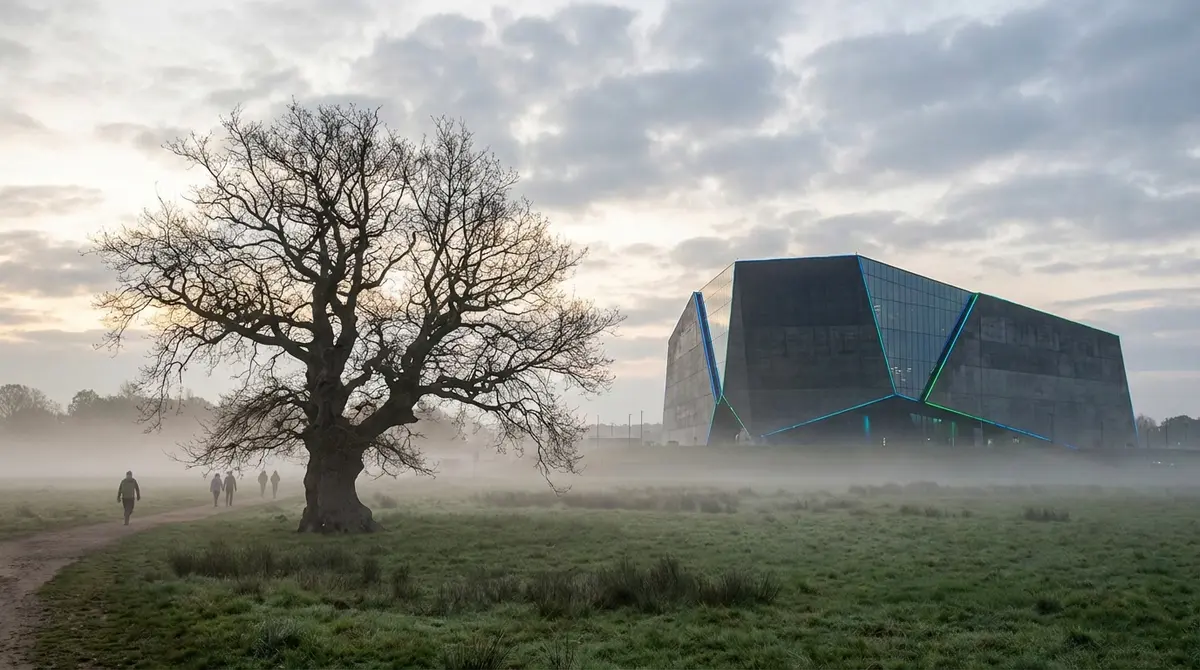
It’s here that a lone oak tree, currently adorned with “NO TO DATA CENTRE” signs, has become the unlikely symbol of a massive conflict between local preservation and the global demand for artificial intelligence. We aren’t talking about a small server room; we are talking about the “Hertfordshire Campus,” a proposed £3.9 billion facility that is set to become one of Europe’s largest data centers.
How did a quiet patch of English countryside become ground zero for the AI arms race? It turns out, when the government decides that computing power is as vital as water or electricity, traditional planning permissions don’t stand a chance.
Why is a small commuter town the center of an AI war?
Potters Bar might seem like a sleepy choice for a hyperscale tech hub, but in the world of data infrastructure, location is everything. The site offers proximity to London’s financial district without the spatial constraints of the city center. However, the sheer scale of this project is what has locals reeling.
The facility is slated to provide over 2 million square feet of floor space. To put that in perspective, that’s roughly the size of approximately 26 football pitches dedicated entirely to the servers that power your ChatGPT prompts and cloud storage. The site is expected to draw more than 250MW of power capacity.
The project gained serious momentum in October 2025, when digital infrastructure giant Equinix acquired the site from the original joint venture, DC01UK (a partnership between Griggs Group and Chiltern Green Energy). Equinix is now leading the charge, and their UK Managing Director, James Tyler, has been clear about the stakes, calling the UK a “cornerstone of the global economy” and a “natural home” for their largest European investment.
What is ‘Critical National Infrastructure’ and why does it matter?
Here is where the story gets really interesting—and controversial. In September 2024, the UK government made a pivotal policy shift: they designated data centers as “Critical National Infrastructure” (CNI). This puts server farms in the same protected category as emergency services, energy grids, and water supplies.
Led by Deputy Prime Minister Angela Rayner and Tech Secretary Peter Kyle, this move was explicitly cited to support projects exactly like the one in Potters Bar. By labeling these facilities as CNI, the government effectively gave themselves a trump card to bypass local planning hurdles. The logic? We need “sovereign AI” capabilities to grow the economy, and we can’t let local zoning disputes slow that down.
The result was swift. Despite fierce opposition from the Potters Bar Special Interest Group, Hertsmere Borough Council granted outline planning permission in January 2025. The CNI designation signaled to local authorities that national interest now outweighs the protection of the Green Belt.
Are local protests actually working?
For the residents of Potters Bar, this feels like a steamrolling. The Potters Bar Special Interest Group, led by Emma Suzuki, has been vocal about the industrialization of their community. Ros Naylor, a spokesperson for the group, summed up the local sentiment, noting that communities are being “kept in the dark” about the massive water and green energy resources these facilities will consume.
While the planning permission in Potters Bar has already been granted, the fight isn’t entirely over in the wider war. In a twist that offers a glimmer of hope to environmentalists, the UK government admitted in January 2026 to a “serious logical error” regarding a separate data center decision in Buckinghamshire. That project was approved without a full environmental assessment, a mistake that could open the door for legal challenges against similar fast-tracked developments.
What does this mean for the future of the UK countryside?
The approval of the Hertfordshire Campus sets a massive precedent. With a global major like Equinix stepping in to acquire the site post-approval, the market has received a clear signal: the UK Green Belt is open for business, provided you are building for AI.
This “green light” for hyperscale infrastructure suggests that the CNI status will likely continue to override local environmental concerns. We could be looking at billions in real estate investment flooding into the Home Counties, transforming pastoral landscapes into high-security compute fortresses.
Oliver Hayes from Global Action Plan argues that Big Tech’s approach to local resources is going unchecked. But as long as the government views AI as the engine of future economic growth, that lone oak tree in Potters Bar may be the last of its kind standing in the way of progress.
Between the Lines
The acquisition of this site by Equinix is the final nail in the coffin for the idea that the Green Belt is untouchable. By designating data centers as Critical National Infrastructure, the UK government has effectively nationalized planning permission for Big Tech, outsourcing the difficult moral trade-offs to a blanket policy. While this ensures the UK remains a tier-one player in the AI economy, the losers are local municipalities who have been stripped of their ability to govern their own geography. This isn’t just about one farm in Potters Bar; it is a blueprint for how the digital economy will physically colonize the physical world over the next decade.
![Illustration related to Equinix Potters Bar Data Center: £3.9B Bet [Analysis]](https://story.bytewire.press/wp-content/uploads/bytewire-images/2026/02/potters-bar-data-center-green-belt-ai-wars-6531295bc7.webp)
![Diagram related to Equinix Potters Bar Data Center: £3.9B Bet [Analysis]](https://story.bytewire.press/wp-content/uploads/bytewire-images/2026/02/potters-bar-data-center-green-belt-ai-wars-c03e02220d.webp)